
With India overtaking China in terms of weightage in the Morgan Stanley emerging markets IMI, Indian equities could see inflows of about $4.5 billion (Rs 37,000 crore), according to estimates. This week, Morgan Stanley announced that India has overtaken China in the MSCI Emerging Markets Investable Market Index (MSCI EM IMI). The weight of India in MSCI EM IMI stood at 22.27 per cent compared to 21.58 per cent of China.

331,602 Indians are studying in the US, making India the 'top sender' of international students to America for the first time in 15 years, as it overtook China for the academic year 2023-2024.

Apple Inc, which had planned to shift only 10 per cent of its global production base from China to India with respect to iPhones at the end of FY26, is currently churning out one out of every four iPhones in the world from India.

China, world's sixth largest economy, has recorded an average nine per cent growth over the last two decades, while India has seen growth touch nine per cent only in the three years till 2007-08. But the global financial crisis ate into this progress and growth slipped to 6.7 per cent in 2008-09.

India has surpassed China to become the world's most populous nation with 142.86 crore people, shows the latest United Nations data, even as UN projections estimate that the country's population is expected to grow for the next three decades after which it will begin declining.

India published 929 generative AI patents in 2024 and 2025 alone -- equating to nearly 70 per cent of the 1,350 patents it published over the entire previous decade (2014 to 2023).

India has pipped China to drive the volume growth of smartphones in the world on the back of falling prices of high-end devices.

In India, the pollution levels are highest in the north.
With around 33 deals valued at USD 647.5 million, India has the highest investment in the fintech segment compared to China's USD 284.9 million during the quarter ended June 30, 2020, the report released by RBSA Advisors said.

India's real GDP grew 8.2 percent in the second quarter of 2025-26, up from 7.8 percent in the first quarter and 7.4 percent in the fourth quarter of the last fiscal.

India must integrate more with East Asia by getting into regional trade arrangements, lower its tariff walls, and improve the quality of its workforce, suggests T N Ninan.

Europe has overtaken Asia as India's biggest arms supplier, reflecting New Delhi's evolving defence procurement strategy.

Tata Electronics has surpassed Taiwanese giant Foxconn in assembling iPhones for export from India during the FY22-FY26 PLI scheme period, with exports valued at $26.3 billion compared to Foxconn's $25.6 billion.

Chinese gold demand slid to a four-year low of 866 tonnes.

The exchange rate of the rupee against the dollar may delay the economy's rise to become the fourth-largest.

India's growth in the last three financial years has averaged just 1.9%. It is natural to project rapid growth from this low base. Crucial to that would be the assumption that the economy has suffered no lasting damage from the pandemic, observes T N Ninan.
Economist Joydeep Mukherji, who tracks India and China for Standard and Poor's, has joined the minority of economists who believe that with a little more effort India can overtake the Chinese economy.\n\n\n\n

Gautam Adani, chairman of Adani group, emphasised that energy and intelligence are inseparable national priorities, asserting that India must build its own capabilities in these sectors rather than relying on external sources, especially in the context of global conflicts and shifting supply chains.

D Gukesh and R Praggnanandhaa secured important wins in Round 7 of the Norway Chess tournament, while Divya Deshmukh defeated Koneru Humpy, boosting India's chances in the competition.

After 2014, our growth has been average of around 5%. If this continues, we will remain here like Egypt, Brazil, South Africa and Bangladesh, points out Aakar Patel.

A day after global brokerage firm Macquarie painted a rosy picture of the Indian economy and raised its target level for the stock indices for the next 12 months, Goldman Sachs said India is set to overtake China and become the fastest-growing emerging market during 2016-18.

The Finance Ministry expects GDP growth to be 8-8.5 per cent in 2015-16.

India has become the world's fourth largest economy, overtaking Japan, according to NITI Aayog CEO B V R Subrahmanyam. He cited IMF data, stating that India's economy is now larger than Japan's, with a USD 4 trillion GDP. Subrahmanyam also highlighted the favorable geopolitical and economic environment for India, predicting that within 2.5-3 years, India will become the third largest economy.

Indian economy is expected to grow at over 7.5 per cent, to overtake China.

'Even if the war ends tomorrow, which is unlikely, and we go back to the pre-war status quo, the world will still need some time to get over the sudden shock of oil price increases.'
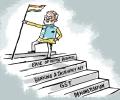
India's GDP expanded 13.5 per cent in the April-June quarter, the quickest pace in a year, to retain the world's fastest growing economy tag but rising interest costs and the looming threat of a recession in major world economies could slow the momentum in the coming quarters.
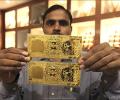
The existing wealthy are poised to gain even greater wealth.

Foreign tourist arrivals in India dropped to 6.18 million during the April-September 2025 period against 7.06 million during the same period last year, which was a drop of 12.4 per cent.

Benchmark indices--Sensex and Nifty--were 0.7-0.8 per cent higher from the Saturday closing. Among the widely-tracked Nifty 50 stocks, 39 advanced and the rest 11 declined at the opening bell. Among the individual stocks, Cipla, ICICI Bank, Sun Pharma, Power Grid Corp, and Bharti Airtel were the top five gainers, while Asian Paints, Hindustan Unilever, Britania, HDFC Bank, and BPCL the losers, NSE data showed. On Monday, Indian stock exchanges were closed for trading on the occasion of Pran Pratistha of Ram Temple in Ayodhya.

The 2025 US National Security Strategy marks a major pullback, with America turning backward and effectively allowing China greater dominance in Asia. while long-time partners like India are left to face an increasingly unstable global order largely on their own, observes Rajeev Srinivasan.

The nation has the fifth largest defence budget in the world, at $52.5 billion in 2017 ($51.1 billion in 2016), overtaking the UK whose defence budget fell from $52.5 billion in 2016 to $50.7 billion in 2017.

India has around 355 million Internet users, second only to China, says a report

Trump may strike. He may announce productive talks and extend again. He may do both at the same time. Iran will not open the Strait on someone else's terms, so no matter what happens, that problem will remain unsolved. And the IRGC will still be collecting its $2 million toll from every ship bold enough to ask permission to pass.

The five largest exporters of major arms in 2020-2024 were the US (43 per cent), France (9.6 per cent), Russia (7.8 per cent), China (5.9 per cent), and Germany (5.6 per cent).

'The real story of 2025 is that India officially stopped being a 'market of the future' and started acting as the world's primary economic engine.'
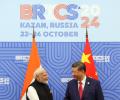
'Don't play the American game... India is too big for a US game.'
Buoyed by favourable policies, India has emerged as the fourth largest destination in Asia for foreign direct investment, attracting over Rs 20,000 crore (Rs 200 billion) within the first six months of the current fiscal year.

India is slowly expanding its share as the third-largest market for smartphones globally in terms of value, even as countries like China, at the top, and the UK, at fifth, have seen declines, according to global data from Counterpoint Research.
